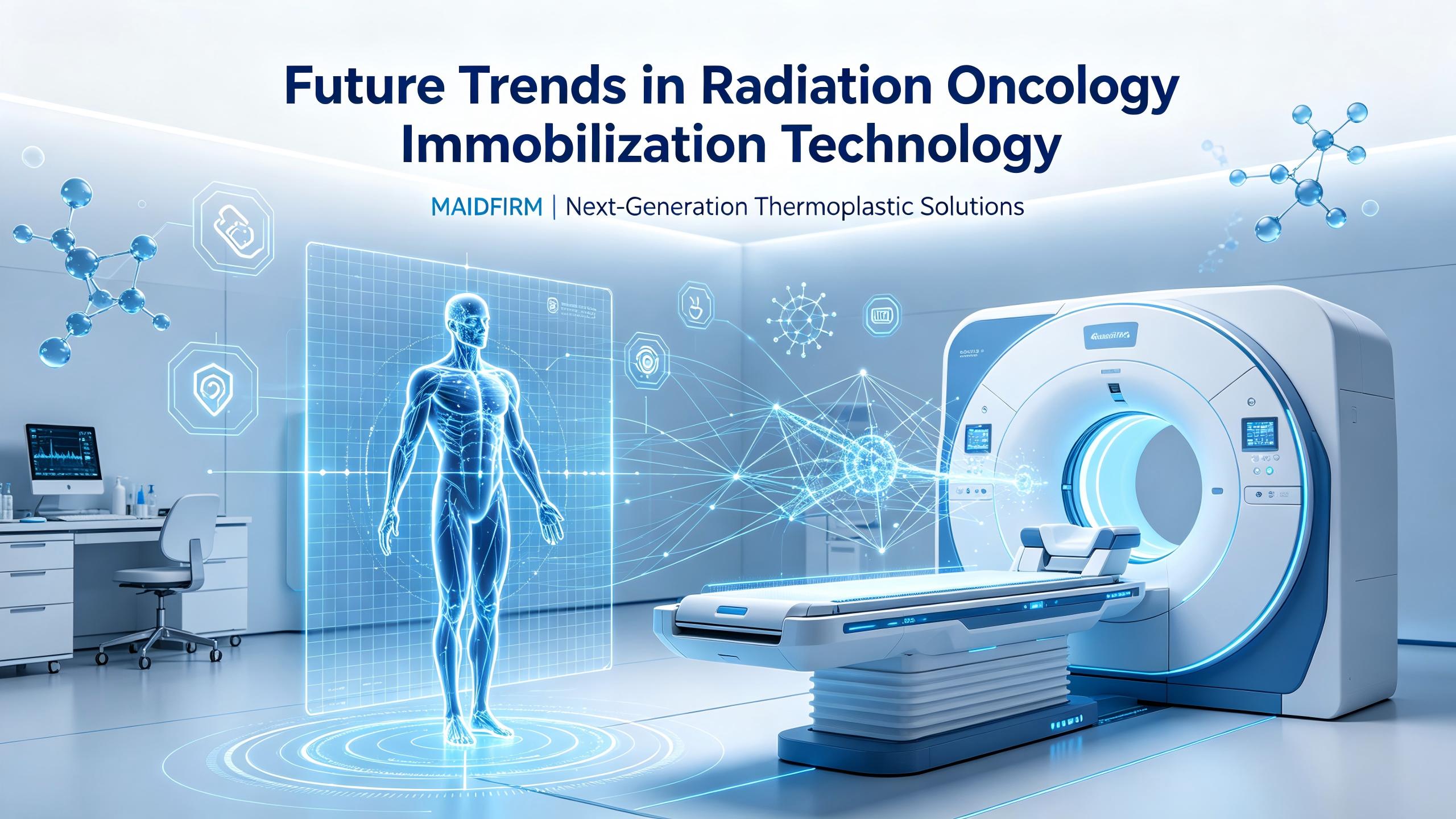
Future Trends in Radiation Oncology Immobilization Technology
How next-generation thermoplastic materials are redefining precision, comfort, and workflow in the treatment room
By MAIDFIRM | Advanced Low-Temperature Thermoplastic Solutions
Introduction: Precision Starts With Immobilization
In modern radiation oncology, every fraction of a millimeter matters. Advanced techniques such as SRS (stereotactic radiosurgery), SBRT, IMRT, and VMAT deliver ablative doses with ever-tighter margins — and that precision is only as good as the immobilization that holds the patient in place. For decades, low-temperature thermoplastic materials have been the clinical gold standard for reproducible patient positioning. But the technology is not standing still.
As an industry-leading manufacturer of low-temperature thermoplastic materials, MAIDFIRM sits at the intersection of materials science and clinical practice. In this forward-looking article, we explore the emerging trends that will define radiation oncology immobilization over the next decade — and how manufacturers, distributors, and oncology departments can prepare for what’s coming.
Trend 1: Smart Thermoplastics with Integrated Positioning Markers
The shift from passive fixation to active alignment.
Traditional immobilization relies on external lasers, tattoos, and rigid index systems to align the patient day after day. The next generation of thermoplastics is beginning to build alignment intelligence directly into the material.
Emerging smart thermoplastic formulations can incorporate:
- Fiducial marker integration — radiopaque markers embedded directly into the mask or sheet during molding, eliminating a separate registration step;
- Indexed grid technologies — precision grids molded into the surface that communicate directly with CBCT and surface-guided systems;
- MR-compatible formulations — non-ferromagnetic materials that maintain imaging fidelity across MRI-linac platforms.
For MAIDFIRM, this means our radiotherapy immobilization masks are increasingly engineered not just to hold position, but to communicate position — reducing setup time, minimizing inter-fraction variation, and giving therapists one less variable to manage.
Trend 2: Antimicrobial Surface Treatments
Cleaner surfaces, safer patients, fewer infections.
Healthcare-associated infections remain a persistent challenge in oncology departments, where patients are frequently immunocompromised. Antimicrobial technologies that were once reserved for wound care and surgical textiles are now migrating into thermoplastic immobilization.
Next-generation surface treatments under development include:
- Silver-ion and copper-based coatings that inhibit bacterial and fungal colonization on the mask surface across the full treatment course;
- Hydrophobic surface engineering that reduces moisture retention — a key factor in biofilm formation — while preserving the non-stick, low-adhesion feel clinicians already value;
- Durable finishes designed to survive repeated heating, cleaning, and disinfection cycles without compromising the material’s molding behavior.
As masks are reused across a single patient’s treatment course (typically 20–35 fractions), antimicrobial durability is not a luxury — it’s becoming a procurement requirement. MAIDFIRM’s R&D is actively evaluating coating systems that balance antimicrobial efficacy with the biocompatibility and optical transparency standards our customers expect.
Trend 3: Patient-Specific, 3D-Printed Hybrid Solutions
From one-size-fits-many to one-patient-one-device.
The convergence of additive manufacturing and thermoplastic materials is opening an entirely new design space. Rather than choosing between a standard pre-cut sheet and a fully custom milled mask, the industry is moving toward hybrid workflows:
- Digital capture — surface mapping or CT-derived contours create a precise digital model of the patient’s anatomy;
- Hybrid fabrication — 3D-printed structural frames or patient-specific cushions are combined with thermoformed low-temperature thermoplastic overlays;
- Personalized comfort zones — anatomical openings, pressure-relief areas, and support contours are optimized for each patient, improving comfort and reducing motion.
This is where MAIDFIRM’s radiation therapy positioning cushions and radiotherapy support boards play a pivotal role. A well-designed hybrid system pairs a supportive, patient-specific cushion with a precision-molded thermoplastic overlay — delivering the reproducibility of rigid fixation with the comfort of custom anatomy.
Trend 4: AI-Assisted Mask Optimization
Machine intelligence in the molding room.
Molding a thermoplastic mask is part science, part craftsmanship. Working time, stretch behavior, and cooling dynamics all influence the final fit. AI is beginning to take the guesswork out of this process.
Practical applications emerging across oncology centers include:
- Molding guidance systems — computer vision that guides technicians through the optimal pull, tension, and cooling sequence for each anatomical site;
- Predictive fit modeling — algorithms that predict final shrinkage and dimensional stability based on material batch data, ambient conditions, and molding technique;
- Workflow analytics — departments mining their own setup data to identify which immobilization configurations yield the lowest residual setup error.
For a materials supplier like MAIDFIRM, AI optimization reinforces what we’ve always believed: material consistency is the foundation. No amount of software can compensate for an unpredictable sheet. That’s why our manufacturing process maintains batch-to-batch uniformity in softening temperature (65–70°C), shrinkage, and working time — giving AI systems a stable, reliable input to optimize around.
Trend 5: Materials for New Treatment Modalities
Immobilization must evolve with the machine.
As delivery technologies advance — FLASH radiotherapy, proton therapy, MRI-guided systems, and stereotactic platforms — immobilization requirements are shifting:
- Ultra-thin, high-rigidity materials for stereotactic applications where beam attenuation must be minimized;
- Low-backscatter, imaging-compatible materials for MR-linac and proton environments;
- Modular, system-agnostic designs that work across Varian, Elekta, and BrainLAB couches and baseplates.
MAIDFIRM’s SRS face masks (SRS 面膜) exemplify this direction: engineered for the sub-millimeter accuracy demands of stereotactic radiosurgery, with open-face configurations that balance rigidity, patient comfort, and airway access. As treatment margins continue to tighten, we expect demand for such application-specific formulations to accelerate.
What This Means for Buyers and Distributors
For procurement teams and distributors, these trends carry three practical implications:
- Look beyond the unit price. The next generation of immobilization products delivers value in setup time, setup accuracy, and infection control — metrics that should be part of any total-cost-of-ownership evaluation.
- Demand material transparency. Batch traceability, documented shrinkage specifications, and consistent softening behavior are non-negotiable when departments build protocols around your product.
- Partner with a manufacturer, not just a supplier. The most successful departments are co-developing solutions with manufacturers that understand both the clinic and the chemistry.
MAIDFIRM offers complete OEM/ODM services across our full portfolio — radiotherapy immobilization masks, positioning cushions, support boards, and SRS masks — with ISO 13485-certified quality management, CE-marked products, and full documentation for every batch we ship.
The Road Ahead: MAIDFIRM’s R&D Roadmap
Looking forward, MAIDFIRM is investing in three pillars:
- Material science — next-generation PCL and hybrid formulations with wider working windows, lower shrinkage, and enhanced surface functionality;
- Design collaboration — working alongside radiation oncologists and medical physicists to co-design site-specific solutions;
- Global supply reliability — expanding production capacity and strategic distribution so that innovation never becomes a supply-chain bottleneck.
Conclusion: Precision Is a Partnership
The next decade of radiation oncology will be defined by smarter machines, tighter margins, and more personalized care. Immobilization technology must keep pace — not as a passive accessory, but as an active contributor to treatment accuracy and patient experience.
At MAIDFIRM, we believe the future of immobilization is a partnership between advanced materials, intelligent design, and clinical collaboration. Whether you’re a hospital evaluating your next mask system, a distributor building a product portfolio, or a system integrator looking for a reliable material partner, we’re ready to build that future with you.
Ready to future-proof your immobilization program?
📧 Contact MAIDFIRM — www.maidfirm.com
🎯 Product Range: Radiotherapy Immobilization Masks · Positioning Cushions · Radiotherapy Support Boards · SRS Face Masks
🏭 Certified: ISO 13485 | CE Marked | Full Batch Traceability
This article was generated with AI assistance. For more information, please contact sales@maidfirm.com.