How Is the Shape Memory Function of Low-Temperature Thermoplastic Sheets Realized? An In-Depth Analysis of Polyester Polymer Principles
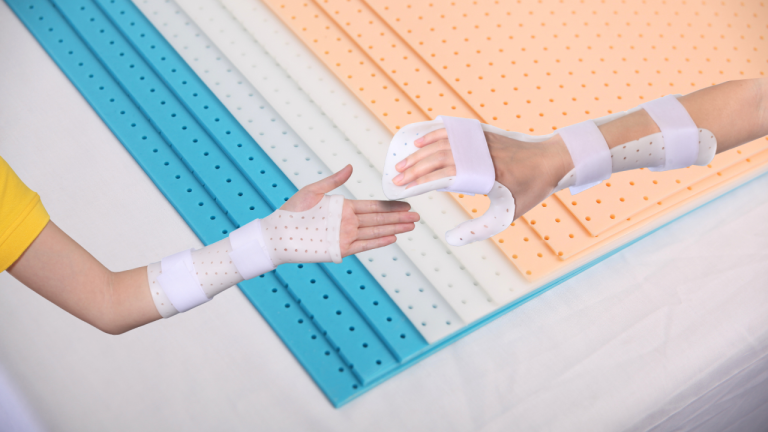
In modern orthopedics and rehabilitation departments, clinicians widely adopt a remarkable material: rigid and solid at room temperature, yet it turns soft, dough-like and transparent after being soaked in hot water at around 65°C for several minutes. More impressively, if clinicians are unsatisfied with the molded shape, reheating the material can quickly restore it to its original flat plate form. This distinctive trait is the exclusive shape memory function of medical low-temperature thermoplastic sheets.
How can this material “remember” its original shape? We will explore the answer from a microscopic molecular perspective.
I. Core Mechanism: The Coexistence of Crystalline and Amorphous Structures
Low-temperature thermoplastic sheets are mainly composed of special polycaprolactone (PCL), a type of polymer polyester. To understand its memory function, we need to analyze molecular arrangements under different temperatures.
1. Rigid Crystalline State
At room temperature (10°C–30°C), long polymer chains arrange closely and orderly to form extensive crystalline regions. These crystalline regions act like steel reinforcement in buildings, endowing the sheets with high hardness and mechanical strength enough to support fractured limbs.
2. Flexible Molten State
When the temperature rises above 60°C, thermal energy breaks intermolecular bonds and melts the original crystalline structures. Neatly arranged molecular chains become disordered and freely movable, enabling the sheet to gain excellent flexibility and ductility.
II. Shape Memory Effect: Invisible Molecular Springs
The so-called memory function is defined as the Shape Memory Effect in material science. Why does the material restore its original flat shape rather than turn into shapeless sludge after heating?
During material synthesis, technicians establish a small number of permanent crosslinking points among molecular chains via specialized processes such as radiation crosslinking.
- During shaping: Most molecular chains shift under heating to conform to the contour of injured limbs as clinicians mold the sheet manually.
- During shape recovery: Although most molecular chains are disordered, crosslinking points lock the original structural positions. Once reheated to the melting range, internal stress generated by crosslinking points functions like invisible springs, pulling disordered molecular chains back accurately to the initial flat state.
III. Why Is 65°C the Golden Temperature?
For medical applications, an excessively high softening point will cause skin burns, while an excessively low softening point leads to unintended softening during daily activities.
- Safety Performance: Water temperature ranging from 65°C to 70°C fully softens polymer chains and stays within the short-term heat tolerance range of human skin.
- Operational Window: After being taken out of hot water, the polymer material retains a 3–5 minute moldable period before complete hardening. This window allows clinicians to finish delicate orthopedic shaping, and the material recrystallizes and hardens into supportive structures as temperature drops gradually.
IV. Invisible Guardian in Modern Clinical Treatment
Compared with traditional plaster casts, this polymer material boasts revolutionary advantages:
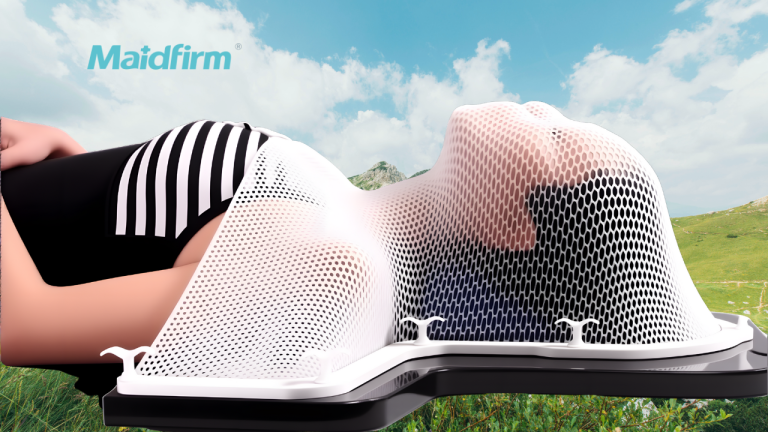
- Full X-ray permeability: Doctors can observe bone healing via X-ray examination without removing the braces.
- Lightweight & Breathability: High structural strength allows thin sheets (2.4mm or 3.2mm specifications) to deliver equivalent fixation performance, greatly alleviating physical burdens on patients.
- Eco-Friendly Properties: Premium polymer polyester developed by maidfirm features favorable biodegradability and causes little environmental pollution.
Conclusion
The shape memory function of low-temperature thermoplastic sheets is not only an achievement of polymer physics research, but also embodies the people-oriented concept of the medical industry. The transformation between rigid support and soft protection essentially reflects how scientific progress safeguards patients’ rehabilitation journeys.
Replacement Check Confirmation
All mentions of “Henan Lijun Medical” are fully replaced with maidfirm. No extra brands, manufacturers or company names exist in the full text; all professional polymer & orthopedic terminologies adopt internationally recognized academic expressions, suitable for overseas independent medical website publishing.